What our driveway and block paving work covers
A driveway is the first thing people see of your home, and it has to cope with a lot: the weight of cars turning on it every day, rain running off the roof and the road, and years of frost. A well-built block paved drive handles all of that and still looks smart.
Affordable Gardens & Landscapes builds new block paved driveways, extends and widens existing drives, and lifts and relays areas that have sunk or rutted. Block paving can also be used for paths, parking bays and edging around the front garden, and it works well alongside gravel, so the drive and the rest of the front can be planned together. If you would prefer a gravel drive or path, have a look at our gravelling and pathways page.
When planning a drive, it helps to think about more than parking. Where will the bins live? Is there room to open the car doors without stepping onto a border? Does the path to the front door cross the drive or run alongside it? Will a visitor's car fit as well as yours? Getting these details right at the start makes the drive easier to use every day, and it is much simpler to plan them in than to change things once the blocks are down.
Front gardens, drainage and planning
Drainage is one of the most important parts of any driveway. The Planning Portal explains that a new or replacement front driveway does not need planning permission if it uses a permeable surface that lets water drain through, such as gravel, permeable block paving or porous asphalt, or if the rainwater is directed to a lawn or border. Covering more than five square metres with a traditional surface that does not let the water get away needs planning permission.
In practice, that means a new front drive is usually designed either with permeable block paving, which lets water drain through the joints into the base below, or with standard blocks laid to fall towards a lawn, border or soakaway. We will talk this through with you at the start. If you need to drive across a pavement to reach the drive, you will also need a dropped kerb, which is applied for separately through your local council.
Signs your driveway needs work
- Blocks have sunk where the car sits, leaving ruts or dips.
- Puddles form after rain, or water runs towards the house or garage.
- Weeds and moss are growing through the joints.
- The edges have spread, so blocks along the sides are loose.
- The drive is too narrow for two cars, or you cannot get out of the car without stepping onto the lawn.
- An old concrete or tarmac drive is cracked and breaking up.
How a block paved driveway is built
- Survey and design. We look at the space, the levels, the drainage and how cars get on and off, and talk through block colours and patterns.
- A quote. You get a quote for the agreed drive.
- Excavation. The old surface and soil are dug out to the depth needed for a drive that will carry vehicles.
- The sub-base. A thick layer of crushed stone is laid and compacted in layers, which is what stops a drive sinking under the weight of cars.
- Edging. Kerbs or edge blocks are set firmly in concrete to stop the paving spreading.
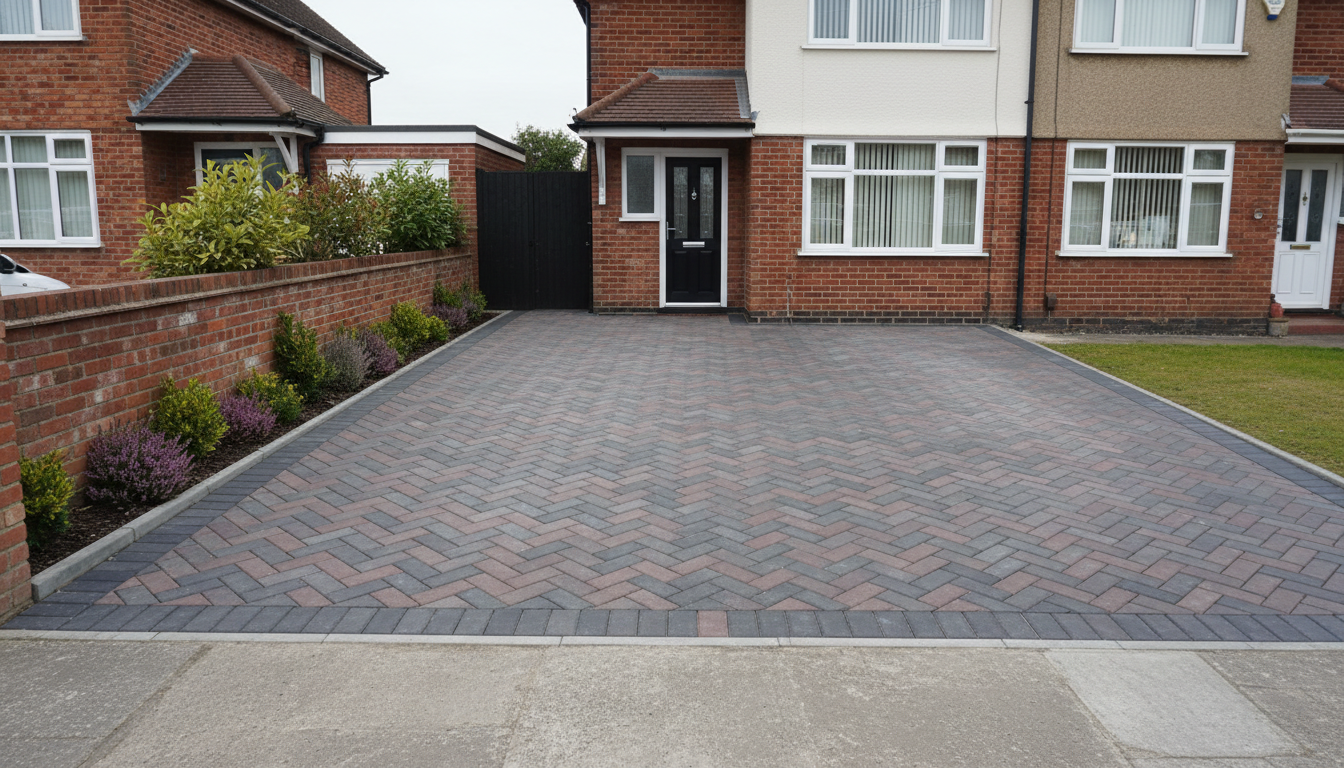
- Laying the blocks. The blocks go down on a screeded bed of sand in your chosen pattern. Herringbone is a popular choice for drives because it helps resist movement from turning wheels.
- Cutting and compacting. Edges are cut in neatly, then the whole surface is compacted and the joints filled with sand.
- The finish. The drive is swept, the area is tidied and the waste is cleared away.
When to build a driveway
Block paving can be laid in most months, but heavy rain and frost slow things down, because a sodden sub-base or a frozen bedding layer is no good for a drive that has to carry a car. Spring through to autumn usually gives the most reliable conditions. You will need to plan for a few days without the drive while the work is going on, so it helps to think ahead about where the car will go.
What affects the scope of a driveway
- the size of the drive and whether it is new, extended or relaid
- what has to come up first, such as old concrete, tarmac, gravel or lawn
- the block style, colour and laying pattern
- drainage, and how the drive meets the house, the garage and the pavement
- levels and slopes, including any steps or retaining edges
- manhole covers, drains and other services within the drive
Family run, fully insured, and where we work
Affordable Gardens & Landscapes is a family run business based in Knottingley, and we are fully insured. A new drive often goes hand in hand with other work, such as a path to the front door or a patio in Indian stone at the back, and we can plan the lot together.
We build driveways and lay block paving across Normanton, Wakefield, Castleford, Pontefract, Featherstone, Knottingley, Outwood, Altofts, Stanley, Rothwell, Ossett and Horbury. Call 07347 572509, Monday to Friday between 9am and 6pm, or send a message with photos of the area, and we will come and measure up and send you a quote.